
Abuela's House
location: Escobilla, Mexico
status: built in 2022
We met Abuela María Luisa in Escobilla, Oaxaca, through her neighbor, Abuela Maricarmen. Our first encounters unfolded through shared meals, storytelling, and long conversations about territory, memory, and responsibility.
María Luisa, a 75-year-old Totonac storyteller and social advocate, and Maricarmen, her collaborator and neighbor, are respected elders in their community. They carry decades of lived knowledge — from food cultivation and animal care to ritual practices and oral narration — shaped by Indigenous traditions passed across generations.
Escobilla is a small village on Mexico’s Pacific coast, known for its sea turtle nesting beaches and tropical climate. It is a territory where biodiversity and livelihood coexist under conditions of economic limitation and environmental fragility.
It was in this coastal landscape, and through our relationship with the Abuelas, that Abuela’s House began to take shape.

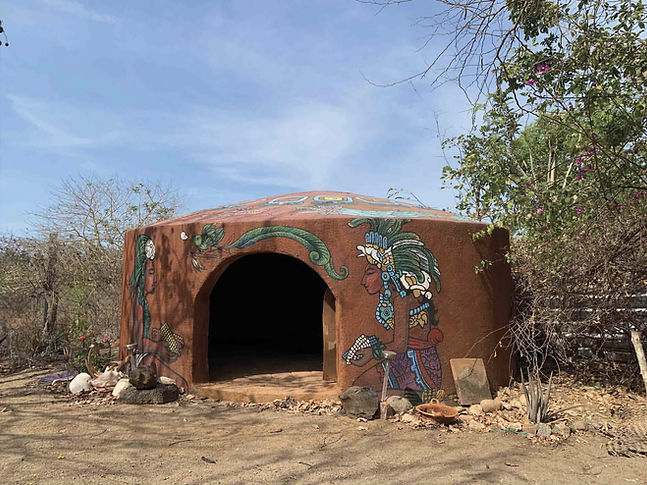
Abuela’s House is a collaborative project developed in relationship with Abuela María Luisa and Abuela Maricarmen, Totonac and Maya grandmothers and community leaders in Escobilla. The project responds to intertwined social and environmental challenges — food insecurity, economic vulnerability, and ecological imbalance — by centering ancestral knowledge as a driver of regeneration.
The house is conceived as a space for oral transmission, shared cooking, spiritual practices, and ecological learning. Through ecological tourism and community education, it supports biodiversity conservation while creating income that does not depend on extractive practices affecting sea turtle habitats.
Architecture here does not introduce solutions — it supports the continuity of knowledge that already sustains land, water, and community life.
A house as environmental,
cultural, and intergenerational
infrastructure.

Immersion & the Encounter
– Entry through long-term relationship with Totonac grandmothers
– Learning from oral tradition, biodiversity care, nutrition, and ritual
– Architecture begins from lived ecology and memory

Co-Creation & Collective Building
– House designed around the Abuelas’ needs and community use
– Spaces for receiving, teaching, cooking, and hosting
– Construction strategies accessible across generations
– Bio-construction techniques rooted in local knowledge

Research, Translation & Commons-Based Knowledge
– Project developed as a master’s dissertation
– Clinical and interdisciplinary research methodology applied
– Oral knowledge translated into spatial, academic, and pedagogical forms


Impact Snapshot
Immersion & the Encounter
– 19 direct collaborators
(7 local women · 5 local builders · 7 women architecture students)
Co-Creation & Collective Building
– $18,000 raised by 409 contributors
– Low-impact construction using local materials and modular systems
Research, Translation & Commons-Based Knowledge
– 11+ universities engaged
– Open-source construction manual (women-centered)
– Graduation thesis
– 8 published articles
– International recognitions and exhibitions
Systemic Continuity
From Jajja’s House emerged:
-
Mothers’ House (developing)
-
Widows’ House (developing)
A single architectural process evolving into a community-led housing system.

